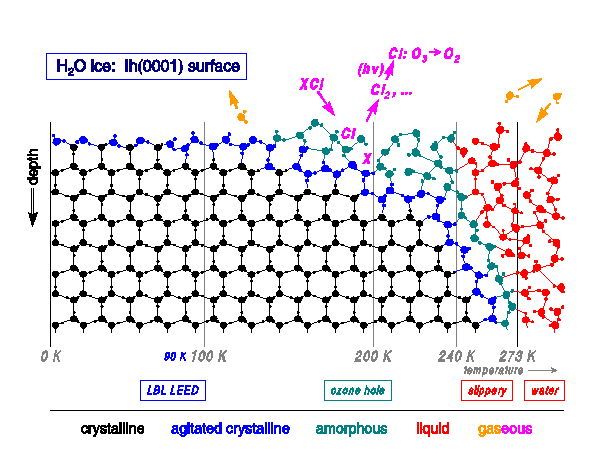
Proposed ice surface structure as a function of temperature
Our proposed evolution of the surface structure of ice is shown as
temperature rises
from absolute zero (at left) to above the bulk
melting point (273 K, at right).
Our LEED result (at 90 K), together with theory,
suggests large vibrational
amplitudes of the outermost water molecules,
still in the crystalline state
(blue).
As temperature rises, molecular agitation induces more crystalline
defects,
yielding an amorphous or quasi-liquid layer (green),
as well as evaporation (orange).
At about 190 K, ice in the Antarctic polar stratospheric clouds
catalyzes Cl-containing molecules to Cl2,
which in turn is dissociated by sunlight into Cl atoms
that decompose ozone
(O3):
the catalytic action may be due to the amorphous or quasi-liquid
ice surface.
Above about 240 K (-30 ºC, -20 ºF), the ice surface probably is liquid (red),
to a thickness of 10s to 100s of Å:
this permanent liquid film can
explain the slipperiness of ice.